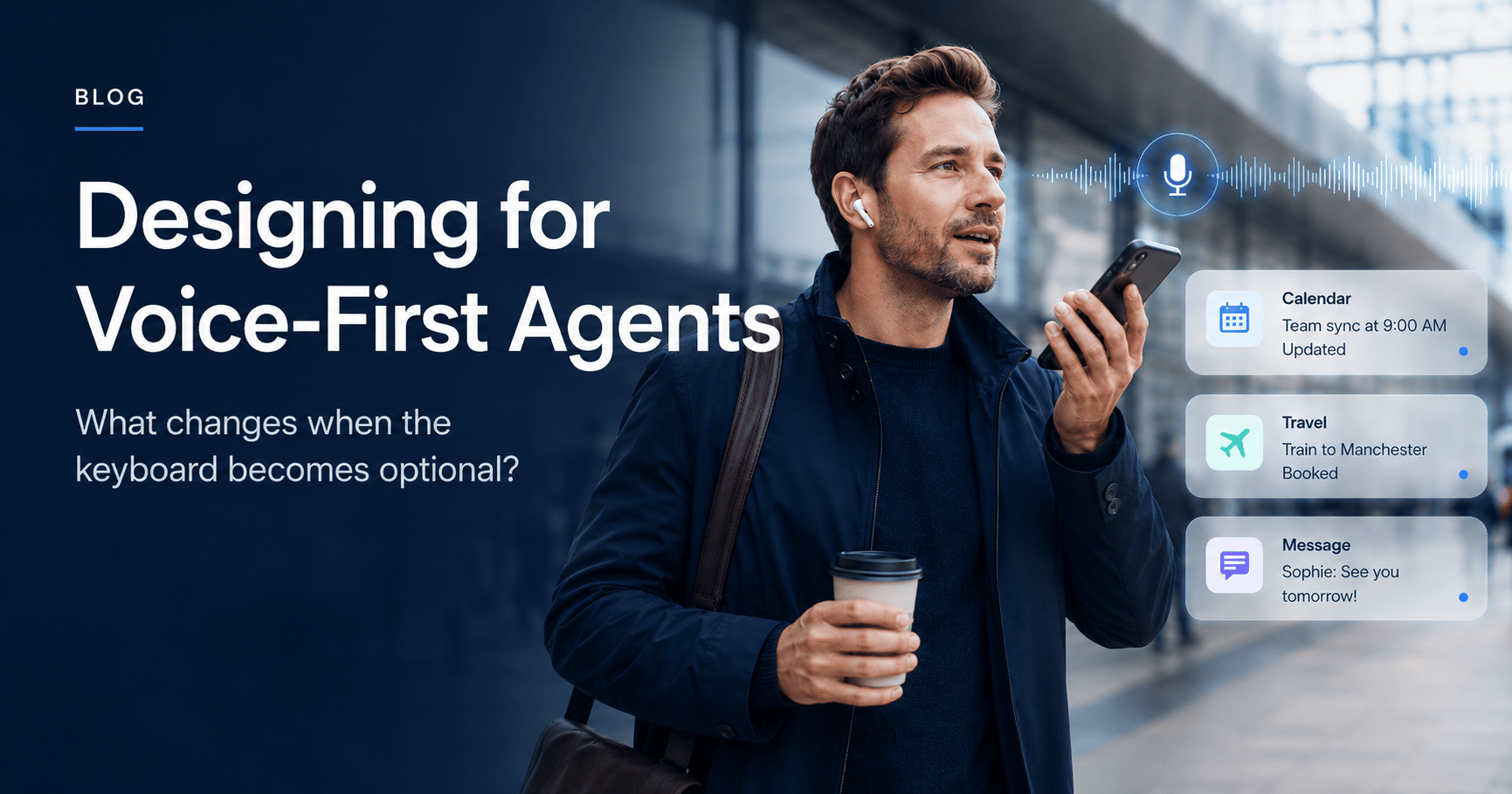
Designing for Voice-First Agents
What changes when the keyboard becomes optional? A field note on latency, intent capture, recovery, and trust in voice-first systems.
What changes when the keyboard becomes optional?
Most digital products are still designed around a familiar assumption: the user can look at a screen, organise a thought and type an instruction. That assumption works reasonably well at a desk, but it becomes less reliable on a mobile device, particularly when the user is walking, travelling, carrying something or dividing attention between several activities.
In these situations, the keyboard is not simply inconvenient; it can become the principal source of friction. Voice offers a more natural way to express an intention, especially when the request contains context, qualifications or several connected steps. However, a voice-first agent is not merely a text-based assistant with speech recognition added to it. Once the keyboard becomes optional, the interaction begins to resemble a conversation, bringing with it a different set of engineering and product-design challenges.

Latency is no longer hidden
Latency exists in every digital system, but voice makes it unusually visible. In a graphical interface, a loading indicator or change of state confirms that the system has received the request. In a voice interaction, the equivalent period is often silence.
Even a short pause can create uncertainty. The user may not know whether the agent heard the instruction, is still processing it or has failed entirely. This often leads to the request being repeated, potentially while the original task is still running.
The design requirement is therefore not only to reduce computational latency, but also to manage perceived latency. A brief acknowledgement — such as confirming that the agent is checking a calendar or searching for available options — can maintain the continuity of the interaction without exposing unnecessary implementation detail.
This becomes particularly important for agentic systems, where a single request may trigger several operations: interpreting the instruction, retrieving information, calling an external service, evaluating possible outcomes and preparing an action. Some delay may be unavoidable, but silence should not leave the user uncertain about the system’s state.
Intent capture matters more than transcription
Accurate speech-to-text conversion is necessary, but it is not sufficient. The more difficult problem is determining what the user intends the agent to accomplish.
Spoken language is rarely as structured as a written prompt. People pause, revise sentences, introduce new constraints and correct themselves while speaking. A request such as:
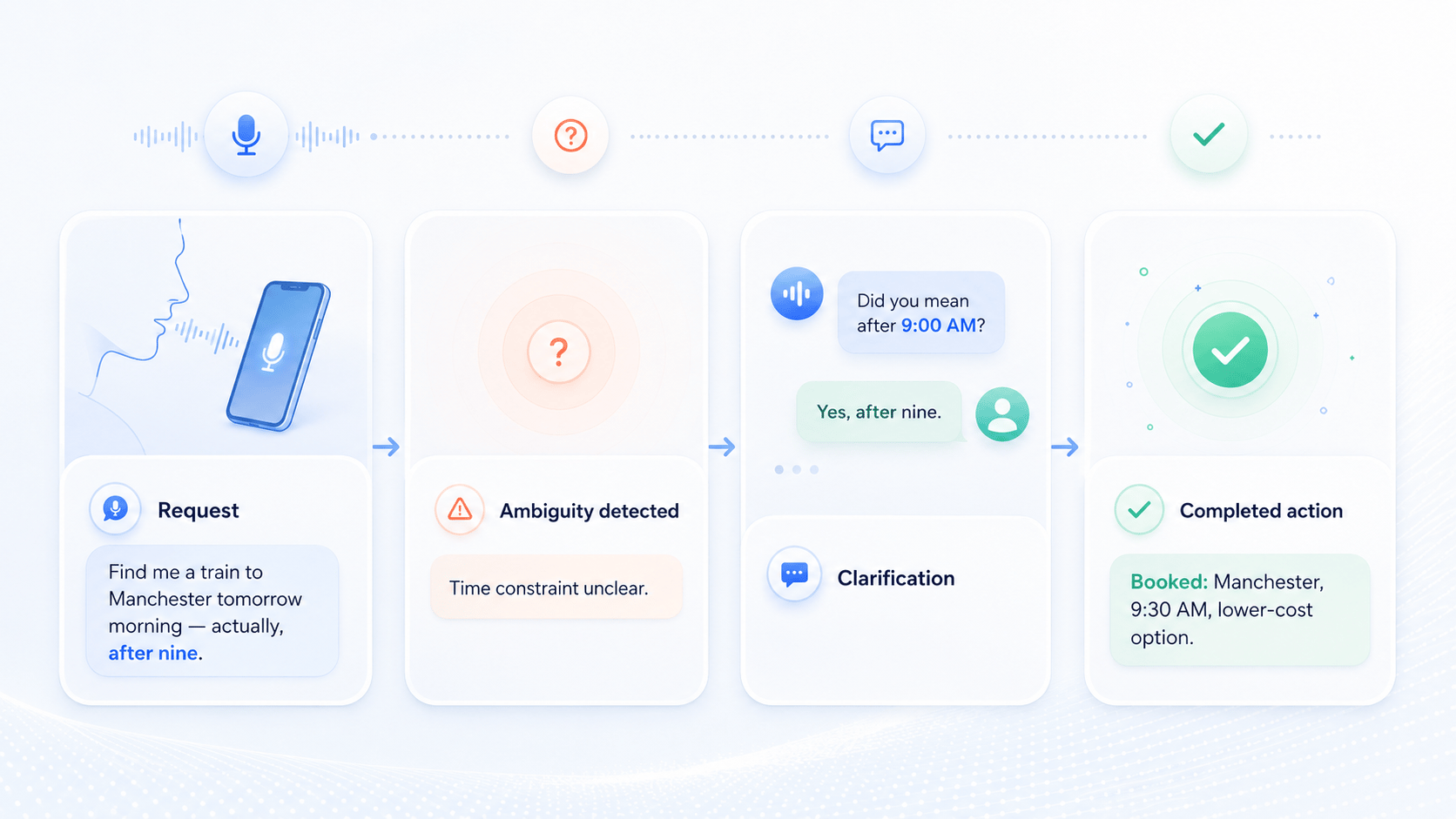
““Find me a train to Manchester tomorrow morning — actually, sometime after nine, and preferably the cheaper option.””
contains an initial objective, a correction and a preference. A literal transcript preserves the words, but a useful agent must identify the final intent and understand how the later information modifies the earlier request.
Voice interaction also relies heavily on conversational context. Instructions such as “book the earlier one”, “send it to her” or “use the other account” are meaningful only when interpreted against the preceding exchange. The system must therefore maintain enough task-specific memory to resolve these references, while avoiding the accumulation of irrelevant information that may confuse later decisions.
It must also recognise whether a new utterance represents a correction, clarification, cancellation, confirmation or entirely new instruction. This distinction is central to voice-first design because users often think aloud rather than formulating a complete command before speaking.
Recovery should not require restarting
Misunderstandings are inevitable. Background noise, unfamiliar names, accents, interrupted speech and poor connectivity can all affect recognition. Ambiguity may also remain even when every word has been transcribed correctly.
The familiar response — “Sorry, I didn’t understand” — is rarely helpful because it gives no indication of which part of the instruction failed. It places the burden on the user to reconstruct and repeat the entire request.
A better approach is to preserve what the system already understands and isolate the uncertain element. An agent might say:
““I understood that you want to travel to Manchester tomorrow. Did you say before or after nine?””
This form of targeted clarification reduces effort and demonstrates that the system has retained the valid parts of the conversation.
For agentic AI, effective recovery is especially important because a misunderstanding may lead not only to an incorrect answer, but to an incorrect action. The agent may send a message, change a booking or initiate a transaction. The recovery mechanism must therefore operate before uncertainty is converted into execution.
Spoken responses require a different information hierarchy
Voice input can be faster than typing, but listening is often slower than reading. A screen allows users to scan, compare alternatives and return to earlier information. Audio is sequential and places a greater burden on memory.
A voice agent that reads every available option may provide a complete answer while creating an unusable experience. Instead, spoken responses should use progressive disclosure: present the most important distinction first, then provide further detail only when requested.
For example:
““I found five trains. The fastest leaves at 9:20, while the lowest-priced option leaves at 10:05. Which would you prefer?””
This is more effective than reading five departure times, prices and ticket conditions in sequence. The aim is not to remove information, but to organise it according to the way spoken information is processed.
The same principle applies to confirmation. Low-risk tasks, such as retrieving information, may require little or no confirmation. Actions with financial, reputational or privacy consequences should require explicit approval. The confirmation itself should focus on the variables that matter: “Book the 9:30 train for £68?” is more useful than repeating the entire search process.
Voice-first should remain multimodal
Voice-first should not be interpreted as voice-only. Voice is effective for expressing intention, while visual interfaces are generally better for reviewing details, comparing alternatives and maintaining a persistent record. Touch remains useful for rapid and unambiguous confirmation.
A user might ask an agent to identify a suitable restaurant near an upcoming meeting. The agent could summarise the strongest options verbally, display their location and availability on the screen, and allow the final selection to be made through either voice or touch.
The objective is not to maximise the amount of speech in the interaction. It is to use each modality where it reduces the most friction.
This is also important for privacy. A user may be comfortable speaking at home but reluctant to do so on public transport or in an open office. Similarly, sensitive information should not be read aloud simply because the original request was spoken. A well-designed multimodal agent should allow the interaction to move naturally between voice, text, screen and touch as the user’s environment changes.
Trust depends on predictable behaviour
Voice can make an AI system appear more human, and therefore more confident or authoritative than its underlying reasoning warrants. A fluent response can conceal uncertainty particularly effectively.
A trustworthy agent should make clear what it has understood, what it has inferred, what it is preparing to do and what has already been completed. Where uncertainty affects the outcome, the system should expose it and request clarification rather than proceed confidently.
The quality of a voice-first product should therefore not be judged primarily by how human it sounds. A more useful test is whether its behaviour remains clear when the conversation is interrupted, incomplete or ambiguous.
Designing for voice-first agents is ultimately not about replacing the keyboard. It is about recognising that, once users can express intentions conversationally, the product must also manage the realities of conversation: latency, revision, uncertainty, interruption and changing context.
For companies developing multimodal agentic AI products, the central question is not whether a user can speak to the system. It is whether the system can maintain a clear, efficient and trustworthy interaction while real life continues around the user.